Why Does My Doctor Say My Ferritin Is Fine?
You’re exhausted, foggy-headed, and dragging yourself through the day, so you finally go to your doctor for blood work. A few days later, you get the call: "Good news, your iron is fine."
Meanwhile, you’re sitting on the couch wondering how on earth you’re supposed to make dinner, let alone live your life with joy and vitality.
If this has happened to you, you’re not crazy, and you’re definitely not alone. Every week in my Nanaimo clinic, I sit across from people who’ve been told their labs look completely normal while their daily lives are falling apart from fatigue and brain fog.
The problem isn’t in your head. It’s in how standard lab reference ranges are interpreted.
The Massive Gray Zone on BC Lab Reports
If you look closely at a standard BC LifeLabs report, you’ll see something that makes very little logical sense. Right on the page, it states that a ferritin level above 100 ug/L represents normal iron stores. Yet, the lab doesn’t actually flag you as iron deficient until your ferritin drops below 15 ug/L.
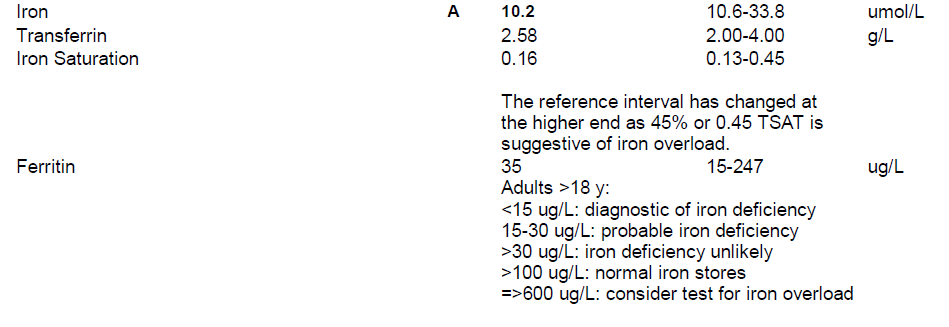
Think about that for a second. How can normal iron stores start at 100, yet you aren’t considered abnormal until you crash all the way down to 14?
That leaves a massive 85-point gray zone where you aren’t flagged medically, so your doctor glances at the page, sees no bolded "L" next to your number, and tells you that you’re fine.
In conventional medicine, lab ranges are built like a bell curve - if you fall inside the statistical majority, you pass. But being "statistically fine" isn’t the same thing as being healthy, energized, or well. In my clinical opinion, if 100 ug/L is the cutoff for normal iron stores, anything below 100 means your tank is running low.
When you’re living in that gray zone between 15 and 100, iron deficiency can show up as:
Crushing fatigue and low daily energy
Brain fog and poor memory
Muscle weakness and poor exercise endurance
Restless legs at night
Dizziness and lightheadedness
Canker sores and mouth sensitivity
Low libido and decreased enjoyment of sex
Hemoglobin vs. Ferritin: The Peanut Butter Analogy
Conventional medicine tends to focus heavily on hemoglobin because it’s the protein actively carrying oxygen through your bloodstream. If your hemoglobin drops too low, you’re officially anemic, and doctors take action. Ferritin, on the other hand, is your stored iron and it often gets brushed aside until you’re already anemic.
To explain why waiting for anemia is a terrible strategy, I like to use an analogy I’ve shared before in my post on how iron deficiency progresses. Imagine walking into a grocery store to buy peanut butter. You look at the shelf and see eight jars sitting there. Those eight jars on the shelf are your hemoglobin. In the back storeroom, there are 18 full cases of peanut butter waiting to restock the shelf. Those cases in the back are your ferritin.
Every day, shoppers buy peanut butter, and the staff restocks the shelf from the back room. For months, you walk into the store and still see eight jars on the shelf, so everything looks "fine" from the outside. Then one day, you walk in and there are only seven jars left because the back storeroom is completely empty.
By the time your hemoglobin drops and you’re flagged as anemic, your reserves are bone dry. At that point, you aren’t just tired, you’re barely functioning.
Just this week, a patient walked me through her daily routine and told me, "I go to work, I come home, and then I sleep for three hours just so I have the energy to get ready and go to bed."
Having to take a three-hour nap just to muster the energy to go to sleep isn’t normal, and I’m not willing to stand for people being told to just live with it.
Please don't even get me started on the trend for women who have male doctors to not even get their ferritin tested (just because their doctor is a man).
Looking Beyond a Single Number
You can’t look at ferritin in isolation and call it a day. When I’m assessing a patient, I want the full picture, which is why I run a complete blood count (CBC), a full iron panel, and an inflammatory marker called high-sensitivity CRP.
Here’s why those extra markers matter so much:
Inflammation masks low iron: Ferritin is an acute-phase reactant, meaning it spikes whenever there’s inflammation in your body. If you’re dealing with chronic inflammation or an illness, your ferritin can look falsely elevated on paper even when your cells are starving for iron. Checking CRP alongside your transferrin saturation (which should ideally be above 20%) helps us spot hidden deficiency. If your CRP is elevated, your ferritin divided by 3 is the amount of iron stores you have access to clinically in your body.
Red blood cell size tells a story: Looking at your CBC shows us the actual size and shape of your red blood cells. Small red blood cells point toward microcytic anemia, while overly large red blood cells can flag a hidden vitamin B12 deficiency, something we can support alongside your iron levels with targeted B12 and B-complex injections.
Just as importantly, we have to ask why your iron is low in the first place. Iron doesn’t just vanish into thin air. Whether it’s heavy monthly periods, a slow gut bleed from an ulcer, hemorrhoids, inflammatory bowel conditions like Crohn’s or colitis, or malabsorption from celiac disease or low stomach acid, we need to find where you’re losing iron or why your gut isn’t taking it in.
Why Oral Iron Often Fails And How IV Iron Works Differently
When you’re told to take an over-the-counter iron pill, you’re fighting an uphill battle.
First, oral iron is notorious for wrecking your stomach with constipation, nausea, and cramping.
Second, your gut simply doesn’t absorb it well especially when you’re stressed or getting older (which we all are, aren't we?).
On average, you’re lucky if you absorb around 3% of an oral iron supplement.
There’s also a built-in physiological catch-22 involving a hormone called hepcidin. When you take a big dose of oral iron, your body senses a sudden influx and releases hepcidin, which literally slams the door shut on further iron absorption for the next 24 to 48 hours.
Plus, whatever tiny fraction does make it through your gut wall goes straight into the portal vein to your liver, leaving your liver to decide how much actually gets released into circulation. You end up stuck in a slow burn where you’re losing iron faster than you can absorb it.
That’s why I lean toward IV iron infusions in Nanaimo for patients whose ferritin is sitting below 100 ug/L. When we infuse iron sucrose (Venofer) directly into your bloodstream, we bypass the gut and the hepcidin roadblock completely.
The iron goes straight where your body needs it to build healthy hemoglobin and replenish your back-room stores. Instead of waiting six months to see your numbers creep up by a few points, most of my patients start noticing real clinical improvements within 3 to 21 days.
You Don’t Have to Settle for Feeling Like Garbage
I’ve administered hundreds of iron infusions, and watching people get their spark back never gets old.
I recently finished a treatment series with a 25-year-old patient who started with a ferritin of 36. Of course her doctor told her she's fine.
Her energy built steadily with every single visit. By the end of her course, she was bouncing around like a little Energizer bunny.
She came in laughing about how her fiancé had to tell her one morning, "This is too much talking for the morning," because she was wide awake, cheerful, and ready to take on the day while he was still getting a grasp on waking up. Now she has her full energy back to pour into her work at a local health clinic and her life ahead.
If your doctor told you that your ferritin is fine, yet you feel like garbage every single day, please trust your gut. Your body is telling you it needs support, and you deserve a practitioner who looks at optimal health rather than just waiting for full-blown disease.
If you’re in Nanaimo or anywhere on Vancouver Island, book a consult with me, get a second opinion, and let’s get your iron stores where they actually belong.
And I've been there with low ferritin, and I'm loving my view from my consistent ferritin of 120. I highly recommend you come join me up here!
References
Soppi ET. Iron deficiency without anemia – a clinical challenge. Clinical Case Reports. 2018;6(6):1082-1086.
Al-Naseem A, Sallam A, Choudhury S, Thachil J. Iron deficiency without anaemia: a diagnosis that matters. Clinical Medicine. 2021;21(2):107-113.
Houston BL, Hurrie D, Graham J, et al. Efficacy of iron supplementation on fatigue and physical capacity in non-anaemic iron-deficient adults: a systematic review of randomised controlled trials.


